

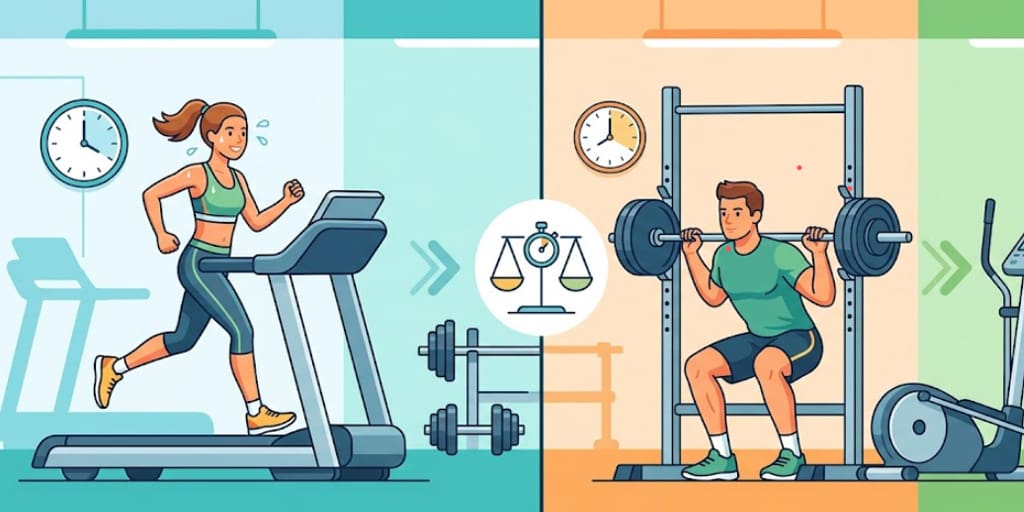
When you do cardio and lifting in one visit, the order can shift which part of the session gets your freshest effort and which energy systems you rely on most. That matters because how you balance strength and aerobic work links to long-term health patterns in different ways, even though both support overall fitness.
Practical bottom line: for many people, consistency matters more than small order changes. The same Cleveland Clinic overview still helps when you have a clear priority: do cardio first if you are building endurance for a race or similar event, do strength first if you want to protect lifting power, and if weight loss is the aim start with whichever mode you are more likely to keep doing. A 2025 randomized trial in forty-five young men with obesity reported larger improvements in fat mass, body fat percentage, and android versus gynoid fat, plus physical activity and MVPA, when resistance came before cycling in matched hour-long sessions; aerobic fitness gains looked similar either way. Hindustan Times relayed an Atlanta coach’s order tips from social media; the article states it is based on user-generated content, that the outlet has not independently verified the claims, and that it does not endorse them.
Doing both in one workout uses different energy systems
Cardio keeps heart rate and breathing up for longer. Lifting uses short, high-force bursts. When you pair them in one workout, the first block can use stored muscle carbohydrate and add fatigue you notice in the second block.
An exercise physiologist at Cleveland Clinic explains in that overview that either order can work for general fitness, but clear goals justify a clearer choice: endurance-first work for stamina-focused sport preparation, strength-first work to protect power for lifts.
What the 2025 trial actually tested and reported
Researchers randomized forty-five young men with obesity into exercise arms plus a control group. For twelve weeks, two training groups completed the same sixty-minute sessions three times weekly; only the sequence changed, with thirty minutes of cycling placed before or after resistance work.
The primary report describes reductions in fat mass and body fat percentage and shifts in android relative to gynoid fat (a common scan-based way to describe upper-trunk versus hip-thigh fat patterning), not a separate headline outcome labeled “visceral fat.” The resistance-then-endurance group also showed larger gains in measured physical activity and moderate-to-vigorous activity (MVPA) than the endurance-then-resistance group. Aerobic fitness gains were similar across orders.
A plain-language summary discussed the same trial using looser phrasing (for example references to daily step counts or visceral-style fat language). Those extras belong to that secondary coverage; they are not a substitute for the primary paper’s outcomes labels.
One proposed explanation in popular write-ups is that lifting first could deplete carbohydrate stores so the following ride relies more on fat oxidation. The trial did not measure glycogen or fat oxidation directly, so treat that story as a hypothesis, not a result of this study.
Limits stay important: young men only, twelve weeks, diet and sleep not tightly controlled, and findings tied to doing both in one workout.
Meta-analysis: a win mainly for lower-body dynamic strength
A systematic review and meta-analysis on within-session order reported a statistically significant benefit for lower-body dynamic strength when resistance training came before endurance work in the same session (roughly a 7 percent pooled change favoring that order in the paper’s summary). It reported no clear sequence effect for lower-body hypertrophy, lower-body static strength, maximal aerobic capacity, or body fat percentage. That narrows how far “weights first always helps strength” claims can travel beyond explosive leg-strength-style outcomes in pooled programs.
Endurance targets, weight loss, and Cleveland Clinic wording
For endurance goals, Cleveland Clinic still recommends cardio first so lifting fatigue does not cap long aerobic work. The same piece cites research that after strength training the body, especially the heart, may need to work harder to achieve the same cardio training effect, which can blunt endurance-focused sessions if you lift hard first.
For weight loss, the clinic does not argue that one order is physiologically superior for everyone. It suggests starting with the modality you are most looking forward to, which is an adherence strategy, not a claim that sequence changes fat loss by itself.
Coach quotes, social sources, and the Hindustan Times disclaimer
Whenever this article cites the Atlanta trainer via Hindustan Times, remember the outlet’s own terms: the report is based on user-generated content, Hindustan Times has not independently verified the claims, and it does not endorse them.
Within that frame, the piece quotes the coach recommending lifting before cardio when fat loss is the stated aim, and cardio first when endurance is the aim, plus a warning about exhausting treadmill work before lifting. Those lines can sit next to trial and clinic material as anecdote, not checked clinical guidance.
Who the trial represents and how to keep it simple
The 2025 trial tested young men with obesity only. Progressive overload and session planning still underpin muscle gains whether you open with cardio or weights.
If you are not training for a specific event, Cleveland Clinic says order matters less: pick the order you will repeat. That keeps the focus on habit, not on small order tweaks.
What you can do next
State your top goal for the next training block (fat loss you can sustain, strength, or endurance). Put the hardest version of that goal first on days when you combine modes and fatigue would otherwise ruin form. If you have cardiovascular disease, pain, or new symptoms, ask a clinician or certified coach before you overhaul order or intensity.
Track consistency for a few weeks before fine-tuning sequence. Regular movement supports mood and may track with lower new use of some psychotropic drugs in large observational data, whether Tuesday starts on the rower or the rack.
Sources and related information
Cleveland Clinic – Is it better to do cardio before or after lifting weights – 2025
The Conversation – Should you do cardio before or after lifting weights – 2025
Hindustan Times – Fitness trainer explains cardio or weights first – 2025
Journal of Strength and Conditioning Research (via PubMed) – Exercise sequence meta-analysis – 2017
The meta-analysis supports a resistance-then-endurance advantage for lower-body dynamic strength only, with no sequence effect for hypertrophy, static strength, maximal aerobic capacity, or body fat percentage in the pooled analysis.
Journal of Sport and Health Science (via ScienceDirect) – Concurrent training order trial – 2025
The trial report documents the twelve-week protocol in forty-five young men with obesity plus controls, matched workloads, and cycling-before-lifting versus lifting-before-cycling.
