Glowing trees cannot light a street. Dutch designer Daan Roosegaarde proposed trees that glow at night in place of street lamps. Later research, marked as updates below, produced plants that make their own light. Their light is a soft green glow, far weaker than the artificial lighting around homes, gardens, and roads.
Where the glowing trees idea came from
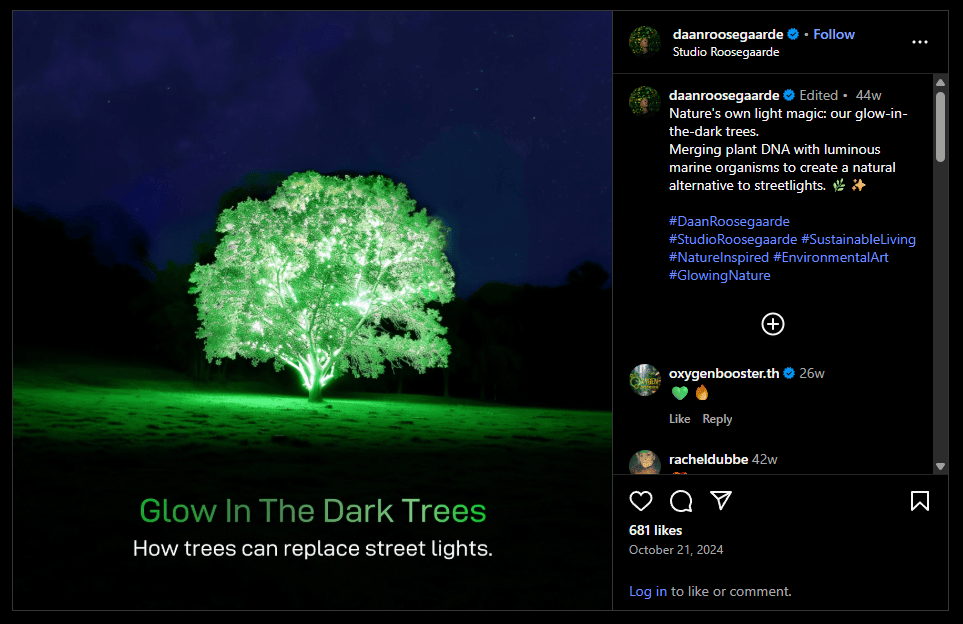
Roosegaarde presented glowing trees as a replacement for street lighting in a filmed interview with the design magazine Dezeen. He worked with Alexander Krichevsky, whose company Bioglow had made a small houseplant glow faintly. Krichevsky added DNA from light-making marine bacteria to the plant, so its stem and leaves gave off a faint light. Roosegaarde planned a large installation shaped like a tree, built from many of these plants.
A popular version of the story says the trees mix plant DNA with jellyfish DNA. In the Dezeen interview, jellyfish and fireflies are the designer’s inspiration, while the genes in Bioglow’s plant came from marine bacteria. Dezeen also described a second plan without genetic modification: a fine “biological paint” for living trees that would charge in daylight and glow at night.
The studio’s built projects use other materials. Under the name Glowing Nature, it later showed an installation of algae that glow when touched, according to its project page. Wired described its glowing road lines in the Netherlands, where green glow-in-the-dark paint marks the edges of a stretch of highway with no street lights.
How bright glowing plants are today
Bioluminescence means a living thing makes light through a chemical reaction. An enzyme called luciferase helps a fuel molecule called luciferin react with oxygen, and the reaction gives off light. To glow without help, a plant has to make that fuel itself.
Early glowing plants used genes from bacteria or fireflies. Wired recounted how those bacterial and firefly plants stayed dim, including a self-glowing plant made at Stony Brook University with marine bacteria genes. The same Wired report says a Kickstarter project promising glowing plants raised nearly half a million dollars, then its company, Taxa Biotechnologies, could not deliver.
Update (2020): a team writing in Nature Biotechnology made tobacco plants glow on their own for life. The researchers added four genes from the glowing mushroom Neonothopanus nambi. These genes turn caffeic acid, a molecule every plant already makes, into luciferin, so the plant needs no added chemicals. According to the paper, light from the flowers reached about 1010 photons per minute (10 billion), and the glow was visible to the naked eye at every stage of growth. The authors report that the plants were at least ten times brighter than earlier plants built with bacterial genes.
Update (2024): a larger team, including several of the same authors, published improved versions of the mushroom pathway in Nature Methods. The paper reports a glow 10 to 100 times stronger in plants, fungi, and mammalian cells. The same paper found that every plant carrying the new versions glowed visibly, including a fast-growing poplar tree. Flowering petunias were the brightest, visible to the naked eye without first letting the eyes adjust to the dark.
Why glowing trees stay too dim for streets
The two papers measure light as photon counts and camera images. Neither converts its results into lux, the unit used to set street lighting levels, so they give no direct figure for a plant against a street lamp. The clearest comparison comes from the company that sells glowing petunias.
Update (2023): Light Bio, co-founded by Karen Sarkisyan and Keith Wood, received permission from the US Department of Agriculture to sell its glowing petunia, the same Wired report says. In its filing to the agency, the company wrote that night lighting from lamps in homes, businesses, and gardens far exceeds the light from its petunias, Wired reported. The filing calls the glow sustained and low-level.
A street lamp has to light the ground well enough for people to see obstacles, faces, and cars. The brightest engineered plants can be seen without letting the eyes adjust to the dark and filmed with a phone, the 2024 paper reports, but the company selling them describes their light as far below ordinary night lighting. None of the sources above describes a street lit by glowing plants or trees.
Related reading
Other Gromeus articles cover living cells engineered to use light or to drive machines: hamster cells modified to use light for energy like plants, and a robot steered by electrical signals from living fungus.
They are talking about it: a Reddit thread on Dutch glowing trees replacing street lights, a public discussion with no measurements, useful only as context.
Sources and related information
Dezeen – Glowing trees could be used instead of street lighting says Daan Roosegaarde – 2014
This filmed interview at SXSW presents Roosegaarde’s plan for glowing trees, his work with Alexander Krichevsky of Bioglow on plants carrying marine bacteria DNA, and the separate biological paint idea.
Nature Biotechnology – Plants with genetically encoded autoluminescence – 2020
Mitiouchkina and colleagues inserted four Neonothopanus nambi genes into tobacco plants that glow on their own throughout life (doi:10.1038/s41587-020-0500-9, volume 38, pages 944-946). The flowers reached about 1010 photons per minute, as the free full text on PMC shows.
Nature Methods – An improved pathway for autonomous bioluminescence imaging in eukaryotes – 2024
Shakhova and colleagues report optimized fungal pathway versions that raise the glow by one to two orders of magnitude, with visibly glowing poplar and petunia (doi:10.1038/s41592-023-02152-y, volume 21, pages 406-410, full text on PMC).
Wired – Here come the glow-in-the-dark houseplants – 2023
This report covers Light Bio’s USDA permission to sell glowing petunias, the history of dim bacterial and firefly plants, the failed Kickstarter project, and the company’s statement that artificial night lighting far exceeds the petunias’ light.
USDA APHIS – RSR request for petunia developed using genetic engineering for luciferin monooxygenation – 2022
Light Bio’s regulatory filing to the US Department of Agriculture describes the petunia’s glow as sustained and low-level, and states that nighttime illumination from artificial lighting far exceeds it.
Wired – Awesome glowing roads that could be the highways of the future – 2014
This article describes Studio Roosegaarde’s glowing road lines on a Dutch highway without street lights.
Studio Roosegaarde – Glowing Nature – n.d.
The studio’s Glowing Nature project page describes its installation of algae that glow when touched.
Studio Roosegaarde – Context – Glow in the dark trees post – 2024
This Instagram post by Studio Roosegaarde is the image shown above and serves as context only, with no measurement attached.
Reddit – Context – Dutch designer glowing trees discussion – n.d.
This Reddit discussion repeats the claim about glowing trees replacing street lights. It is background only and supports no figure in this article.