

Neuroscience
Insights into the biological foundations of consciousness and the human experience.
Brain Basics
Virtual avatars rewire body perception and ease trauma through brain plasticity
When people use virtual reality (VR) to embody avatars, such as taller, younger, or more muscular versions of themselves, their…
We create a false self in early life to meet external expectations and cope with childhood experiences – James Hollis
James Hollis explores the psychological and spiritual upheaval of midlife as a necessary and meaningful rite of passage. Drawing from…
Learning a second language early strengthens brain connections and efficiency
Learning a second language is linked to a more efficient brain network. A research team reports that people who speak…
Psychological abuse leaves real trauma effects
Psychological abuse and coercive control are linked to PTSD, depression, and measurable trauma-related brain changes. The evidence is strong, but it does not show identical or permanent damage in every survivor.

Learning multiple new skills can produce test scores comparable to adults 30 years younger
Older adults who learn multiple new skills simultaneously can achieve cognitive performance similar to adults 30 years younger. A UC Riverside study found that 3 months of intensive learning improved memory, attention, and cognitive control, with gains maintained up to one year later.
Brain Habits
Teen brain shifts toward new voices around age 13
A Stanford fMRI study suggests the teen brain becomes less uniquely tuned to a mother's voice and more responsive to unfamiliar voices around age 13. The finding fits normal social development, but it does not prove that teenagers stop listening to parents.
Why you suddenly spot something everywhere once it matters to you
The “frequency illusion”, also called the Baader-Meinhof phenomenon The frequency illusion, also known as the Baader-Meinhof phenomenon, occurs when something…
Benefits of forgetting: why memory sometimes lets go
Benefits of forgetting help the brain stay flexible. Learn how adaptive forgetting updates memories, protects focus, and why not every lapse is a loss.
Use your name, not I, to quiet your mind
When worry loops take over, it becomes harder to see problems clearly. A simple language shift can help. This method…
Sleep deprivation makes you angrier by disrupting brain control
New research confirms sleep deprivation triggers anger by disrupting the brain's ability to regulate emotions via the amygdala and prefrontal cortex.
Oxytocin social bonding: vole study shows how love and loss change the brain
A review of oxytocin social bonding in prairie voles shows the hormone helps form pair bonds and that social loss disrupts oxytocin, causing depression.
Brain Research

Memory rejuvenation restored recall in mice
An EPFL Neuron study found that brief OSK gene activation in memory-trace neurons improved recall in aged and Alzheimer's-model mice. The result suggests some memory decline may reflect aging neurons rather than erased memories, but it does not show human memory restoration.

A fully synthetic scaffold grows brain-like tissue without animal coatings
UC Riverside researchers report a fully synthetic scaffold that grows functional brain-like tissue without animal-derived materials or added biological coatings.
Long COVID brain fog linked to a change in brain cell receptors
Long COVID brain fog linked to higher AMPA receptors on PET scans; new study points to a biological marker and possible AMPAR-targeted treatments.
Spinal cord ejaculation study reshapes sex research
A 2025 mouse study found that spinal cord neurons help shape sexual arousal, pacing, and ejaculation. It does not show that the spinal cord replaces the brain or that the same mechanism is proven in humans.
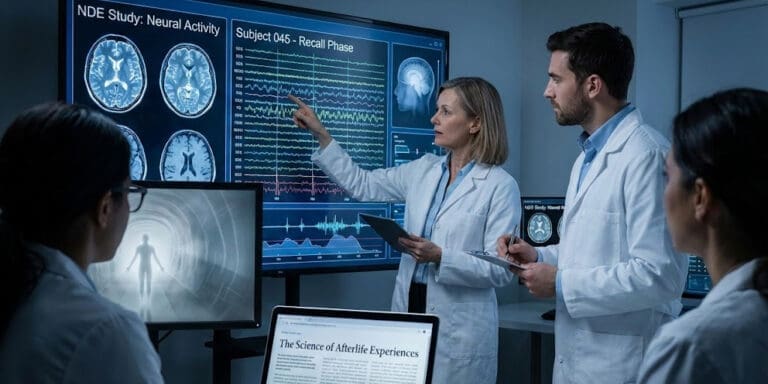
Scientists study near death events, but proof of life after death is still missing
Near death reports now meet modern tools in hospitals. We see short windows of organized brain activity while the heart is stopped, and we see rare moments of mental clarity before death. These observations keep the debate open, but they do not prove life after death.
AI enables first recorded 20-minute interactive exchange between humans and a humpback whale
An artificial intelligence system has enabled humans to engage in a 20-minute interactive exchange with a humpback whale, marking a…