Senolytic drugs are medicines designed to kill senescent cells: worn-out cells that stop dividing but do not die, and that build up in the body with age. In old mice, a senolytic mix of two compounds, dasatinib and quercetin, improved physical function and lengthened remaining life by 36%. In people, the first small trials show that the same mix is tolerated, but they have not yet shown a clear health benefit.
What senolytics are and why they target aging cells
A senescent cell is an aged or damaged cell that has stopped dividing. It stays alive and releases inflammatory signals that can harm the tissue around it. These cells add to the low-grade, long-lasting inflammation of old age, one of the processes behind the idea that aging weakens the body and disease causes death.
Senolytics (the word means “dissolving senescent cells”) aim to remove these cells while sparing healthy ones. The best-studied senolytic is a combination called D+Q. D is dasatinib, a prescription drug approved to treat certain blood cancers. Q is quercetin, a natural plant pigment found in many fruits and vegetables and also sold as a supplement. Quercetin is one of the supplements and drugs most discussed for living longer.
Senolytics are given in short courses of a few days, followed by long breaks. According to the Alzheimer’s trial described below, this intermittent schedule reflects how the drugs act: they trigger the death of senescent cells.
What senolytics did in old mice
The study behind that figure was published in Nature Medicine in 2018 by a Mayo Clinic team, and it worked in two steps. First, the researchers transplanted small numbers of senescent cells into young, healthy mice. That was enough to make the mice weaker and slower (lower grip strength, walking speed, and endurance) and to spread senescence to their own tissues.
Next, the researchers gave D+Q by mouth to naturally old mice, at 5 mg of dasatinib and 50 mg of quercetin per kg of body weight, every two weeks. Treatment started at 24 to 27 months of age, which the paper equates to 75 to 90 years in humans. The treated mice lived a median 36% longer after the start of treatment, the same study found. Their risk of death at any given time was 64.9% of the risk in untreated mice, according to the same paper.
The same study found that D+Q also reduced the number of senescent cells, and their inflammatory signals, in samples of human fat tissue kept alive in the lab. These results come from mice and lab samples. They show that clearing senescent cells can help old animals, and they do not show what the drugs do in people.
First human trial in Alzheimer’s: well tolerated, no memory change
In September 2023, researchers in Texas published a first trial of senolytics in people with early Alzheimer’s disease. Five patients with a mean age of 76 completed the 12-week trial, which had no placebo group, according to the paper. Each course, according to the same paper, was 100 mg of dasatinib and 1,000 mg of quercetin on two days in a row, repeated every two weeks.
The trial found dasatinib in the spinal fluid (the fluid around the brain and spinal cord) of four of the five patients, while quercetin was not detected there. The treatment was well tolerated and no one stopped early. Memory tests and brain scans did not change significantly. The authors present the results as evidence of safety and feasibility, and they call for larger trials with a placebo group to test whether the drugs help.
Update (2024): the bone trial in older women missed its main goal
Update (2024): a phase 2 randomized trial in 60 postmenopausal women tested D+Q on bone, one of the conditions senolytics are hoped to protect against. The women, all over 60, took 100 mg of dasatinib for two days and 1,000 mg of quercetin for three days, every 28 days for 20 weeks, according to the paper. The control group received no treatment, and the trial was open-label: everyone knew which group they were in.
The main measure, a blood marker of bone breakdown, did not differ between groups: the median change was -4.1% with D+Q and -7.7% without it, the trial reported. A blood marker of bone building rose 16% more with D+Q than without it at 2 and 4 weeks, but the difference was no longer significant at 20 weeks, the same paper found.
In an exploratory analysis, the authors looked at the third of women with the most senescent cells in their blood. In that group, the authors found that bone density at the forearm rose 2.7% at 20 weeks. No serious side effects occurred, and headache and stomach complaints were the most common ones, according to the paper. The authors conclude that D+Q did not reduce bone breakdown in the women as a whole, and that future trials should test whether people with many senescent cells respond better.
Senolytics and heart disease, bone loss, and memory: where the evidence stands
Senolytics are being developed in the hope of delaying heart disease, bone loss, and memory decline. Update (2024): according to the bone trial authors, clearing senescent cells in old mice has improved frailty, memory, blood sugar control, and heart function. In people, the Alzheimer’s trial showed no change in memory, and the bone trial reported in the update above missed its main goal. None of the human trials described here measured heart outcomes, so the effect on heart disease in people is unknown based on available sources.
Dasatinib is a prescription cancer drug, and both trials gave it under medical follow-up. Update (2024): the bone trial authors write that there is little data so far on the safety or benefit of these drugs in otherwise healthy older people. Check these figures against the sources below before acting on them.
Senolytics are one of several drug approaches to aging under study. Another is rapamycin, a drug that may slow aging in animals and help older immune systems.
Sources and related information
Nature Medicine – Senolytics improve physical function and increase lifespan in old age – 2018
Xu and colleagues at the Mayo Clinic show that transplanted senescent cells weaken young mice and that intermittent D+Q given to very old mice lengthens their remaining life and reduces senescent cells in human fat tissue samples. Paper: doi.org/10.1038/s41591-018-0092-9.
Nature Medicine – Senolytic therapy in mild Alzheimer’s disease: a phase 1 feasibility trial – 2023
Gonzales and colleagues report the first open-label trial of D+Q in five people with early Alzheimer’s disease: dasatinib reached the spinal fluid, treatment was well tolerated, and memory and brain scans did not change significantly. Paper: doi.org/10.1038/s41591-023-02543-w (ClinicalTrials.gov NCT04063124).
Nature Medicine – Effects of intermittent senolytic therapy on bone metabolism in postmenopausal women: a phase 2 randomized controlled trial – 2024
Farr and colleagues report the randomized trial of D+Q in 60 postmenopausal women: no effect on the main bone breakdown marker, a short-lived rise in a bone building marker, and better results in women with the most senescent cells. Paper: doi.org/10.1038/s41591-024-03096-2 (ClinicalTrials.gov NCT04313634).
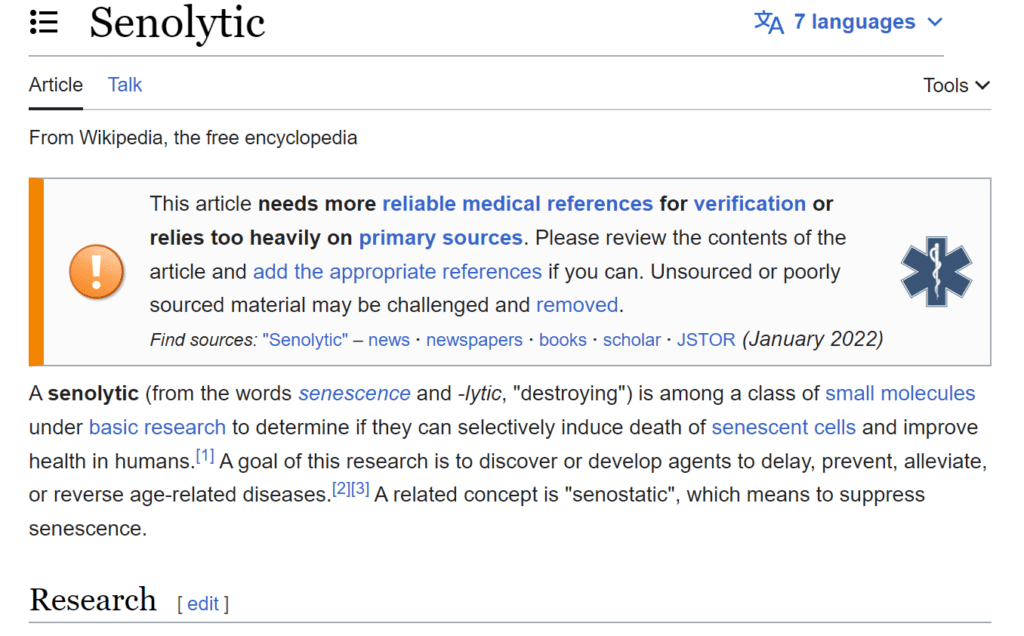
Wikipedia – Context – Senolytic – n.d.
The original source of this article, a general overview of senolytic drugs. It is background only: no figure in this article comes from it.