

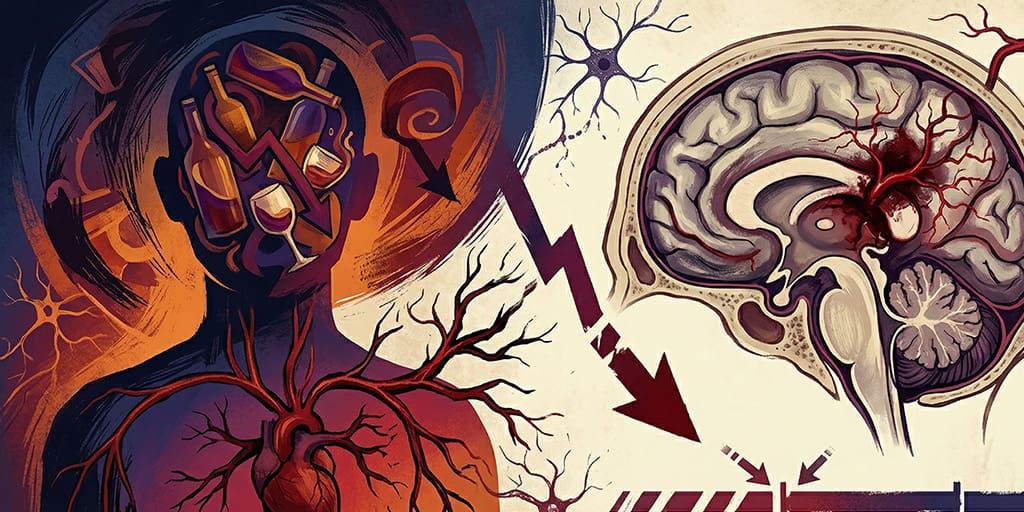
A single-center Neurology analysis of 1,600 consecutive patients admitted with spontaneous, nontraumatic intracerebral hemorrhage associates heavy, regular drinking with earlier first bleeds, larger clots on imaging, and MRI patterns that fit more advanced cerebral small vessel disease, relative to patients without heavy alcohol use. Intracerebral hemorrhage is a devastating event, and alcohol intake is a modifiable habit clinicians can discuss once risks are understood in context.
This article stays close to that paper for the main numbers, uses an institutional summary for plain-language alignment, and separates what the scan data supports from claims about overall brain atrophy that this study did not measure.
Younger first bleeds and larger hematomas in heavy drinkers
Researchers defined heavy alcohol use (HAU) as regular consumption of three or more drinks per day. The study used prospectively collected data on consecutive patients at Massachusetts General Hospital from 2003 through 2019 with spontaneous nontraumatic intracerebral hemorrhage; 104 people (about 7%) met HAU criteria, and the overall group median age was 75 years (interquartile range 64 to 82). The analysis compared them with the non-HAU cohort (patients below that heavy-use threshold, not only abstainers).
In models reported in the same Neurology paper, HAU was associated with younger age at bleed (median 64 years versus 75 years in the non-HAU cohort), about 1.7-fold larger hematoma volume, higher odds of deep hemorrhage location (adjusted odds ratio 2.01, 95% confidence interval 1.11 to 3.64) and intraventricular extension (adjusted odds ratio 1.95, 95% confidence interval 1.02 to 3.70), along with lower platelet counts and higher admission blood pressure.
MRI findings suggest more advanced small-vessel disease
In the MRI portion of the Neurology cohort, 1,195 patients (75% of those enrolled) contributed scans. After adjustment, heavy use remained associated with severe white matter hyperintensities (adjusted odds ratio 3.04, 95% confidence interval 1.43 to 6.49) and with a hypertensive cerebral small vessel disease pattern (a pattern of damage in tiny brain blood vessels linked to high blood pressure; adjusted odds ratio 1.82, 95% confidence interval 1.04 to 3.20). Other small-vessel MRI markers tested in the study did not show independent links to HAU.
A Mass General Brigham news summary of the same findings describes heavy drinkers presenting with brain bleeds earlier in life and showing more imaging signs of small-vessel injury, matching the quantitative story in the journal article without adding new statistics here.
Why the study shows association, not direct causation for each finding
The Neurology report is cross-sectional and draws from one tertiary hospital, so it describes people already admitted with intracerebral hemorrhage rather than following drinkers forward in time to count new events. Alcohol use was self-reported and grouped by regular intake, and the authors note a lack of detailed lifetime drinking history. MRI was not available for the full cohort, which can skew who enters the imaging analyses.
Those constraints mean the paper is strong for patterns among admitted patients and for adjusted associations between heavy drinking and imaging severity markers. It does not, on its own, prove that alcohol directly causes each hemorrhage feature in an individual patient, and the discussion frames HAU as a factor that may worsen acute severity and interact with small-vessel pathology rather than as proof of the exact mechanism behind every scan finding.
What this study measured (and did not)
This study did not measure global or overall brain atrophy. It measured acute bleed features (size, location, extension) and selected MRI markers of cerebral small vessel disease. Review-level work on drinking in later life is wider context on how alcohol may relate to structural brain and cognitive measures across populations; it does not change what this hemorrhage cohort was designed to test, and results in that literature vary by study and consumption level.
What to do with the information
General clinical guidance (not from the Neurology study itself): Intracerebral hemorrhage is a medical emergency. Anyone with sudden severe headache, weakness, speech trouble, or altered awareness should seek immediate emergency care rather than rely on articles for diagnosis or treatment. In Mass General Brigham’s coverage of the study, the corresponding author describes brain bleeds as among the most lethal and disabling conditions people can face, which underscores why rapid care matters.
For prevention questions outside an emergency, the study supports discussing personal drinking with a clinician in light of blood pressure, platelet health, stroke risk, and any prior imaging that showed white matter changes.
Limitations and evidence quality
The backbone of the article is a large, peer-reviewed Neurology cohort with multivariable adjustment. The design is observational, cross-sectional, and single-center, with MRI on a subset of patients and limited detail on lifetime alcohol exposure. An institutional summary echoes the main associations without adding conflicting numbers. Together, that supports cautious reading: strong signals of association in admitted patients, not a license to infer direct causation or exact mechanisms for every finding.
Sources and related information
PubMed – Effects of Heavy Alcohol Use on Acute Intracerebral Hemorrhage and Cerebral Small Vessel Disease – 2025
The open PubMed record for the Neurology article supports every quantitative claim about sample size, drink threshold, age medians, hematoma volume, adjusted odds ratios, MRI subset findings, and stated study limitations used in this summary.
Neurology – Effects of Heavy Alcohol Use on Acute Intracerebral Hemorrhage and Cerebral Small Vessel Disease – 2025
The journal landing page for the Neurology report backs the inline citations used for prospectively collected consecutive admissions, the 1,600-patient denominator, the MRI subgroup counts, and the adjusted odds ratios quoted in the body. The article first appeared online ahead of the December 2025 issue.
Mass General Brigham – Heavy Alcohol Use Linked to Risk of Brain Bleed Earlier in Life – 2025
This Mass General Brigham press release corroborates the public-health framing that heavy alcohol use clusters with earlier intracerebral hemorrhage presentations and imaging patterns suggesting small-vessel stress, notes self-reported alcohol use and study limits, and includes the corresponding author’s statement that brain bleeds rank among the most lethal and disabling conditions people can face, without adding numbers beyond those already taken from the primary paper.
PMC – Context – Effects of drinking on late-life brain and cognition – 2023
This PMC review of drinking and late-life brain outcomes supports only the article’s use of independent literature as background: structural brain correlates of alcohol vary across studies and consumption patterns, and that work should not be read as if this hemorrhage paper had tested overall brain atrophy.