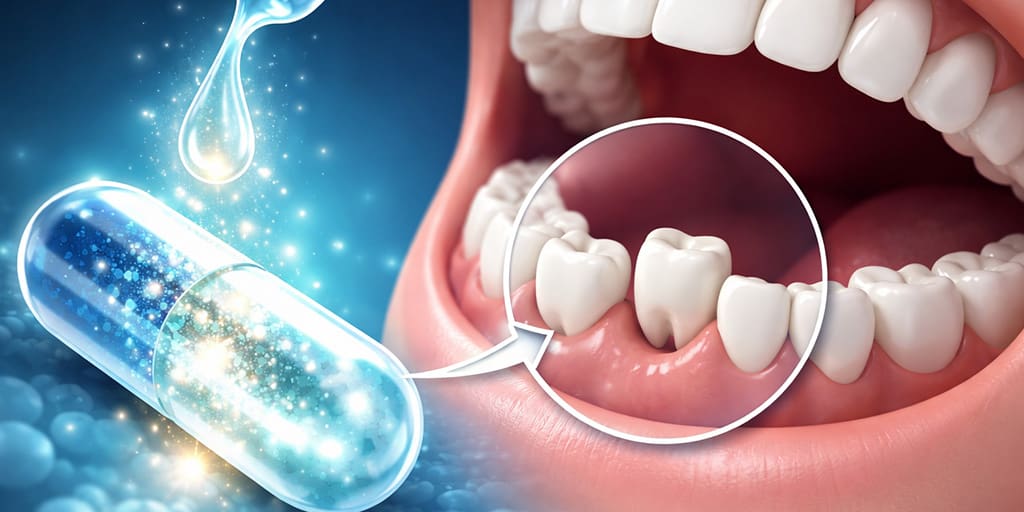
Missing teeth affect chewing, speaking, and confidence. Current solutions like dentures and implants replace lost teeth but cannot restore natural growth. A drug that blocks the USAG-1 protein could enable natural tooth regrowth in humans, offering a third option beyond replacement devices.
Kitano Hospital reports that an investigator-initiated Phase I first-in-human trial is underway in cooperation with Kyoto University Hospital (Ki-CONNECT), with an implementation period from September 2024 to August 2025. The trial tests safety of an anti-USAG-1 antibody drug called TRG035. The treatment aims to help people with congenital tooth agenesis, a condition where teeth never develop. If successful, the researchers aim to make the drug available for dentists to use by 2030.
How blocking USAG-1 enables tooth regrowth
The USAG-1 protein normally limits tooth development by interacting with both bone morphogenetic protein (BMP) and Wnt signaling pathways. USAG-1 suppresses BMP signaling, which restricts tooth formation. When USAG-1 is blocked, BMP signaling increases, which can reactivate dormant tooth germs and stimulate new tooth formation.
Research published in Science Advances in 2021 showed that mice lacking USAG-1 developed extra teeth. The researchers developed monoclonal antibodies that block USAG-1’s interaction with BMP. Candidate antibodies aim to disrupt the BMP interaction preferentially to reduce systemic effects, since both BMP and Wnt pathways are involved in many developmental processes. A single injection of an anti-USAG-1 antibody was sufficient to induce tooth formation in ferrets, which have two sets of teeth like humans.
The antibody treatment is cell-free, meaning it does not require stem cell transplants or tissue engineering scaffolds. This makes it simpler than other regenerative approaches.
Clinical trials target congenital tooth loss
The Phase I trial is conducted at Kyoto University Hospital (Ki-CONNECT) and involves approximately 30 adult males aged 30 to 65 who are missing at least one molar. The study is designed to assess safety and determine appropriate dosing in healthy volunteers, not to test effectiveness yet.
The drug, called TRG035, is a humanized version of the anti-USAG-1 monoclonal antibody. It is being developed by Toregem BioPharma (also stylized TreGem) with support from the Japan Agency for Medical Research and Development.
If Phase I shows the drug is safe, a Phase IIa trial is planned for children aged 2 to 7 who were born with four or more congenitally missing teeth. This phase would test whether the treatment can actually restore tooth growth in humans.
Potential benefits and limitations
Reported prevalence of tooth agenesis varies widely by definition and population. Severe congenital forms involving six or more missing teeth are rare (around 0.1% in Japan, per Kitano Hospital), while milder forms are more common in epidemiological studies. The condition can appear alongside other genetic conditions like ectodermal dysplasia. Current treatments include dentures and dental implants, but these do not restore natural tooth development.
If the anti-USAG-1 treatment proves effective, it could help people who lost teeth due to congenital factors, severe cavities, or dental diseases. The researchers envision it becoming a third option alongside dentures and implants.
However, several unknowns remain. The treatment has worked in animal models, but human tooth development is more complex than in mice or ferrets. Safety must be confirmed, as BMP and Wnt signaling pathways are involved in many other developmental processes. Functional aspects like root shape, tooth eruption timing, and alignment also need assessment.
Limitations and quality of evidence
The research is promising but still early. The 2021 Science Advances study showed effectiveness in mice and ferrets, but human trials are just beginning. Phase I focuses on safety, not efficacy, so whether tooth regrowth will work in humans remains unproven.
The treatment targets congenital tooth agenesis specifically. Whether it could help people who lost teeth from other causes, such as injury or decay, is not yet known. Long-term safety, optimal dosing, and the functional quality of any regenerated teeth also need evaluation.
The timeline to potential availability by 2030 depends on successful completion of multiple trial phases and regulatory approval, which is not guaranteed.
What you can do about it
If you or someone you know has congenital tooth agenesis, you can follow updates on the clinical trial through Kitano Hospital’s website. The treatment is not yet available, and participation in trials is limited to specific criteria.
For now, dentures and dental implants remain the standard options for missing teeth. Consult with a dental professional to discuss the best current treatment options for your situation.
Remember that this research is still in early stages. While promising, the treatment may not be suitable for everyone, and results from animal studies do not always translate to humans.
Sources and related information
Euronews – A drug that makes teeth regrow: scientists move closer to clinical trials – 2023
An article describes how Japanese researchers are developing a drug to enable tooth regrowth. The research, led by Dr Katsu Takahashi at Kitano Hospital in Osaka, targets the USAG-1 protein. Clinical trials were scheduled to begin in 2024, with the goal of making the treatment available by 2030 for people with congenital tooth loss.
Kyodo News – Japan pharma startup developing world-first drug to grow new teeth – 2023
A report notes that a Japanese pharmaceutical startup is working on a drug to stimulate tooth growth, aiming for market availability around 2030. The treatment would be a world first if successful.
Science Advances – Anti-USAG-1 therapy for tooth regeneration through enhanced BMP signaling – 2021
A research study found that blocking USAG-1 with monoclonal antibodies can stimulate tooth regeneration in mice and ferrets. The treatment is cell-free and requires only a single injection. The study demonstrated that antibodies that block USAG-1’s interaction with BMP, but not Wnt, are most effective and have fewer side effects.
Kyoto University – New drug to regenerate lost teeth – 2021
A press release explains how USAG-1 interacts with both BMP and Wnt pathways, and why candidate antibodies aim to disrupt the BMP interaction preferentially to reduce systemic effects. The research showed that a single administration of anti-USAG-1 antibody could induce tooth formation in ferrets.
Kitano Hospital – Clinical trial information – 2024
The hospital’s official information describes the investigator-initiated Phase I clinical trial for TRG035, conducted at Kyoto University Hospital (Ki-CONNECT) from September 2024 to August 2025. The trial involves approximately 30 adult males aged 30-65 with at least one missing molar and focuses on safety assessment. Future phases are planned for children aged 2-7 born with four or more congenitally missing teeth. The drug is being developed by Toregem BioPharma with support from AMED.