UC Riverside researchers report a fully synthetic scaffold on which functional, brain-like tissue can be grown without animal-derived materials or added biological coatings. The work is intended to make neurological research more controlled and could reduce the need to use animal brains in some research. The scaffold is currently about two millimeters wide; the team is scaling it up and has submitted a related paper on liver tissue.
How the synthetic scaffold works
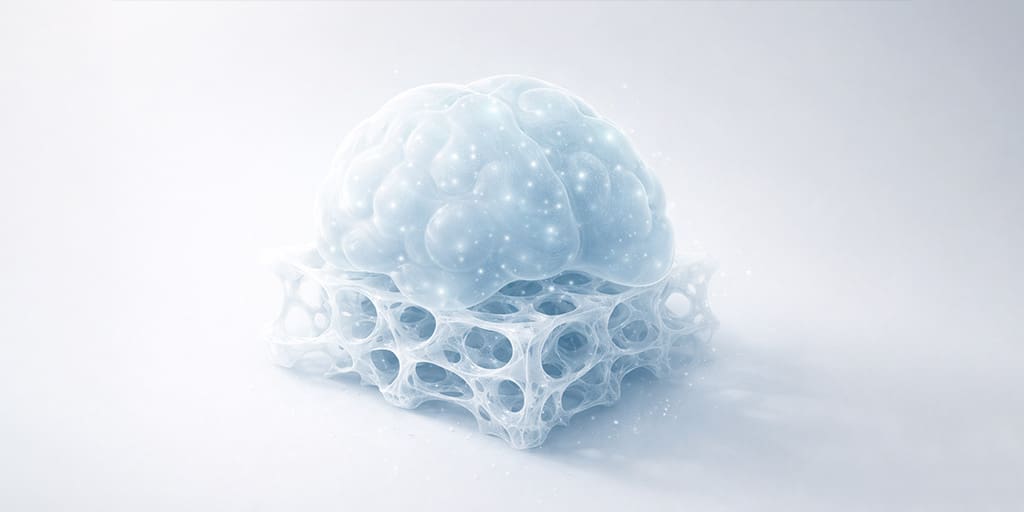
In the paper, the team calls the approach BIPORES (Bijel-Integrated PORous Engineered System), referring to a bijel-inspired pore structure (a method that creates smooth, interwoven, sponge-like pores from separating liquids). It is made mainly from polyethylene glycol (PEG), a chemically neutral polymer. Cells typically do not stick to PEG unless it is coated with proteins such as laminin or fibrin. The researchers turned PEG into a porous, interconnected network so that neural stem cells can attach and build functional neural networks without animal-derived materials or added biological coatings.
The structure was made by flowing a mix of PEG, ethanol, and water through nested glass capillaries. Where this stream met a water stream, the components began to separate; a flash of light fixed that structure, locking in a sponge-like layout. The pores let oxygen and nutrients move through the scaffold, which helps sustain cells over longer cultures.
Why an animal-free scaffold matters
Many brain tissue platforms rely on biological coatings that are hard to standardise, which can make experiments less reproducible. Using rodent brains for human-relevant questions is limited by genetic and physiological differences. This scaffold could reduce the use of animal brains in some research and fits with the FDA’s push to reduce and replace some animal tests using new approach methodologies (NAMs), including initial focus areas such as monoclonal antibodies.
Because the material is stable, it allows longer-term culture. Mature brain cells better reflect real tissue when studying diseases or trauma. The team suggests the scaffold could be used to model traumatic brain injury, stroke, and neurodegenerative conditions such as Alzheimer’s, and that donor-derived neural stem cells may support donor- or patient-specific testing in the future.
Limits and next steps
The scaffold is only about two millimeters across. The group is working to scale it up and has submitted a paper on applying the same approach to liver tissue. Their long-term goal is a set of lab-grown organ-level cultures that communicate, to study how one tissue responds to a treatment and how one organ can affect another. For now, this is a research tool, not a therapy; practical impact depends on scaling and adoption by other labs.
Sources and related information
UC Riverside News – Scientists engineer first fully synthetic brain tissue model – 2025
The university reports that researchers led by Iman Noshadi, with Prince David Okoro as lead author, engineered a fully synthetic scaffold for brain-like tissue without animal-derived materials or biological coatings. It cites the FDA’s move to phase out animal testing and quotes the team on stability, longer-term studies, and possible use in modelling brain injury and disease.
Advanced Functional Materials – BIPORES scaffold (DOI 10.1002/adfm.202509452) – 2025
The primary peer-reviewed study describes the BIPORES scaffold and its PEG-based, bijel-inspired porous structure. It supports the claims that the material is fully synthetic, allows neural cell attachment and formation of functional networks without animal coatings, and is suitable for controlled neural tissue engineering.