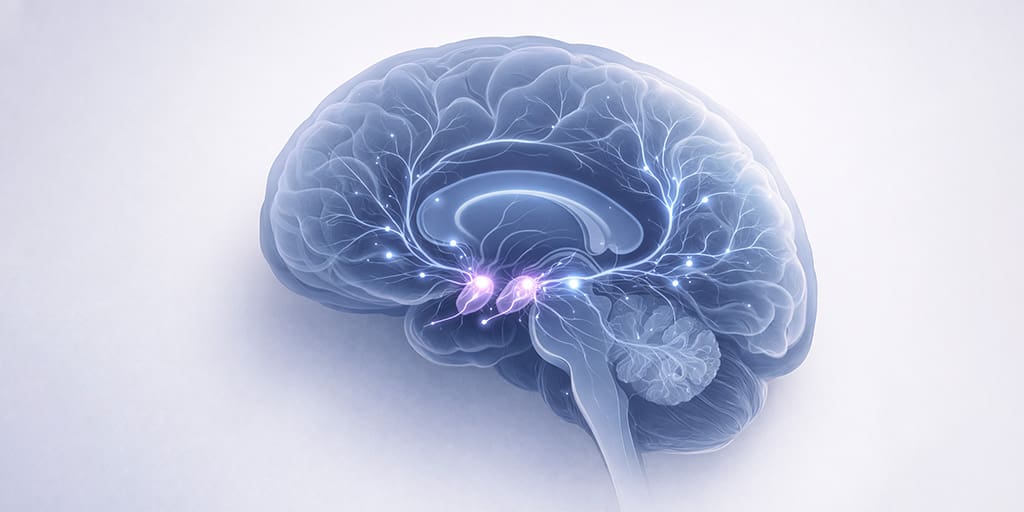
Anxiety disorders affect around 359 million people worldwide (2021 estimate), making them the most common of all mental disorders. New research suggests that targeting specific neurons in the amygdala, a brain region involved in emotion processing, could reverse anxiety behaviors. Scientists from the Spanish National Research Council and Miguel Hernández University of Elche found that normalizing GRIK4 gene dosage in basolateral amygdala pyramidal cells reversed anxiety-like, depression-like, and social deficit behaviors in mice that were overexpressing the GRIK4 gene. This builds on previous research showing that the amygdala plays a crucial role in emotional regulation and that imbalances in specific brain cell populations can drive mental health symptoms.
How GRIK4 gene overexpression drives anxiety behaviors
The GRIK4 gene produces a protein called GluK4 that plays an important role in brain cell communication. In mice with extra copies of the GRIK4 gene (overexpression), increased GluK4 production is associated with anxiety-like behaviors. These animals avoid open spaces, show reduced social comfort, display signs of depression-like behavior, and struggle with object recognition tasks.
Targeting the basolateral amygdala
The researchers focused on the basolateral amygdala (BLA), a specific region within the amygdala that processes emotional memories and threat responses. They used viral delivery of Cre recombinase (AAV-Cre) to normalize GRIK4 gene dosage specifically in BLA pyramidal cells of mice overexpressing GRIK4. This intervention successfully lowered GluK4 protein levels to normal. The adjustment reversed anxiety-related behaviors, depression-like behaviors, and social deficits in the treated mice, but did not rescue object recognition memory impairments.
Regular-firing centrolateral amygdala neurons identified as key regulators
Beyond identifying the gene, the research team pinpointed regular-firing neurons in the centrolateral amygdala (CeL) as key regulators of anxiety symptoms. When GRIK4 dosage was normalized in BLA pyramidal cells, this restored synaptic strength in regular-firing CeL neurons but not in late-firing CeL neurons. The mice’s behavioral measures improved, suggesting that anxiety disorders may stem from imbalances in particular brain cell populations rather than widespread brain dysfunction. Similar targeted approaches are being explored in other neurological conditions, such as research showing how specific neuron populations can be reprogrammed to repair brain circuits.
The treated mice still showed difficulties with object recognition memory tasks, indicating that other brain regions affected by anxiety disorders were not corrected by normalizing GRIK4 dosage alone. This suggests that anxiety involves multiple brain circuits, and targeting specific neuron populations may address some symptoms while leaving others unchanged.
GRIK4 knockdown effects in mice with varying anxiety levels
The researchers tested GRIK4 knockdown in BLA neurons of mice with conditional (floxed) GRIK4 alleles that were classified as either non-anxious or highly anxious based on open-field behavior. In non-anxious mice, GRIK4 knockdown had no effect on anxiety levels. In highly anxious mice, GRIK4 knockdown only mildly attenuated anxiety. These results suggest that GRIK4 activity may play a role in anxiety disorders, but the effects are more modest when tested beyond the overexpression model.
Limitations and quality of evidence
This research was conducted entirely in mice, and the same processes have not yet been observed in human brains. While mice are considered good scientific models for brain research, translating these findings to human treatments will require extensive additional research. The study identifies a promising target for anxiety treatment but does not prove that similar viral delivery approaches would be safe or effective in humans.
The research was published on May 13, 2025, in iScience (volume 28, issue 6, article 112649), a peer-reviewed scientific journal. The authors declare no competing interests. The study provides early evidence for a targeted approach to treating anxiety disorders by focusing on specific neural circuits rather than broad brain-wide interventions.
What you can do about it
This research is in early stages and focuses on animal models. There are currently no viral delivery or gene normalization treatments available for anxiety disorders based on this research. If you experience anxiety, consult healthcare professionals who can recommend evidence-based treatments such as therapy, medication, or lifestyle interventions that have been tested in human trials.
For general anxiety management, regular exercise has been shown to reduce anxiety and depression. Maintaining good sleep quality also supports emotional regulation, as sleep deprivation disrupts the brain’s ability to manage emotions.
Sources and related information
iScience – Central role of regular firing neurons of centrolateral amygdala in affective behaviors – 2025
Researchers from CSIC-UMH demonstrated that normalizing GRIK4 gene dosage in basolateral amygdala pyramidal cells reversed anxiety-like, depression-like, and social deficit behaviors in mice overexpressing GRIK4, but not object recognition memory impairments. The study identified regular-firing neurons in the centrolateral amygdala as key regulators whose imbalanced activity triggers pathological anxiety behaviors and showed that restoring synaptic strength in these circuits reverses symptoms.