

Neuroscience - All posts
This archives page shows all posts of this category. Go back to category guide: Neuroscience »
 video
videoListening to theta binaural beats may help calm and sleep
Binaural beats are a sound effect made by playing two slightly different tones, one in each ear. The brain perceives…
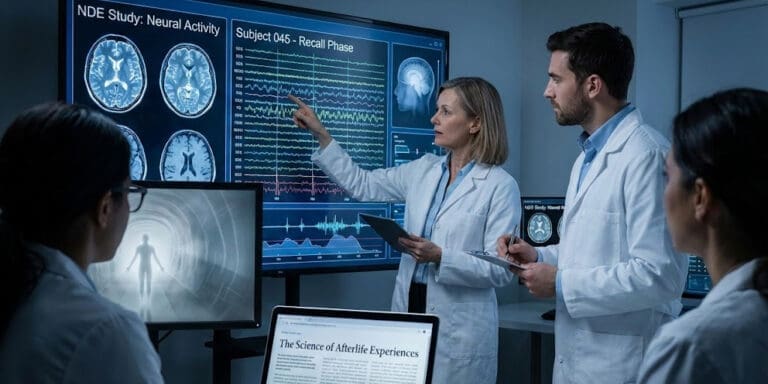
Scientists study near death events, but proof of life after death is still missing
Near death reports now meet modern tools in hospitals. We see short windows of organized brain activity while the heart is stopped, and we see rare moments of mental clarity before death. These observations keep the debate open, but they do not prove life after death.
Taking strategic breaks every 90 minutes keeps the brain sharp
An anonymous Redditor claiming to be a cognitive scientist posted the following message in r/Biohackers: As a cognitive scientist, I’ve…
AI enables first recorded 20-minute interactive exchange between humans and a humpback whale
An artificial intelligence system has enabled humans to engage in a 20-minute interactive exchange with a humpback whale, marking a…
Virtual avatars rewire body perception and ease trauma through brain plasticity
When people use virtual reality (VR) to embody avatars, such as taller, younger, or more muscular versions of themselves, their…

Fixing one gene’s activity reversed anxiety signs in mice
Researchers identified regular-firing neurons in the centrolateral amygdala that drive anxiety behaviors. Normalizing GRIK4 gene dosage in basolateral amygdala pyramidal cells reversed anxiety, depression, and social deficits in mice overexpressing the gene, suggesting a targeted treatment approach for anxiety disorders.
Amygdala circuit tweak clears anxiety signs in mice
A May 2025 iScience mouse study (online 13 May 2025; print issue 20 June 2025) reports that normalizing Grik4 in basolateral amygdala pyramidal cells reversed anxiety-like behavior, depression-like behavior, and social deficits in a transgenic model, while object recognition stayed impaired. In non-transgenic mice that were already highly anxious on screening, the same approach yielded only partial relief of anxiety-like behavior on the elevated plus maze, not a broad reversal across domains. The work is preclinical and does not establish a human treatment.
Neurons employ multiple learning rules simultaneously
Brain learning involves multiple simultaneous synaptic rules, challenging traditional models New research reveals that the brain does not use a…
We create a false self in early life to meet external expectations and cope with childhood experiences – James Hollis
James Hollis explores the psychological and spiritual upheaval of midlife as a necessary and meaningful rite of passage. Drawing from…