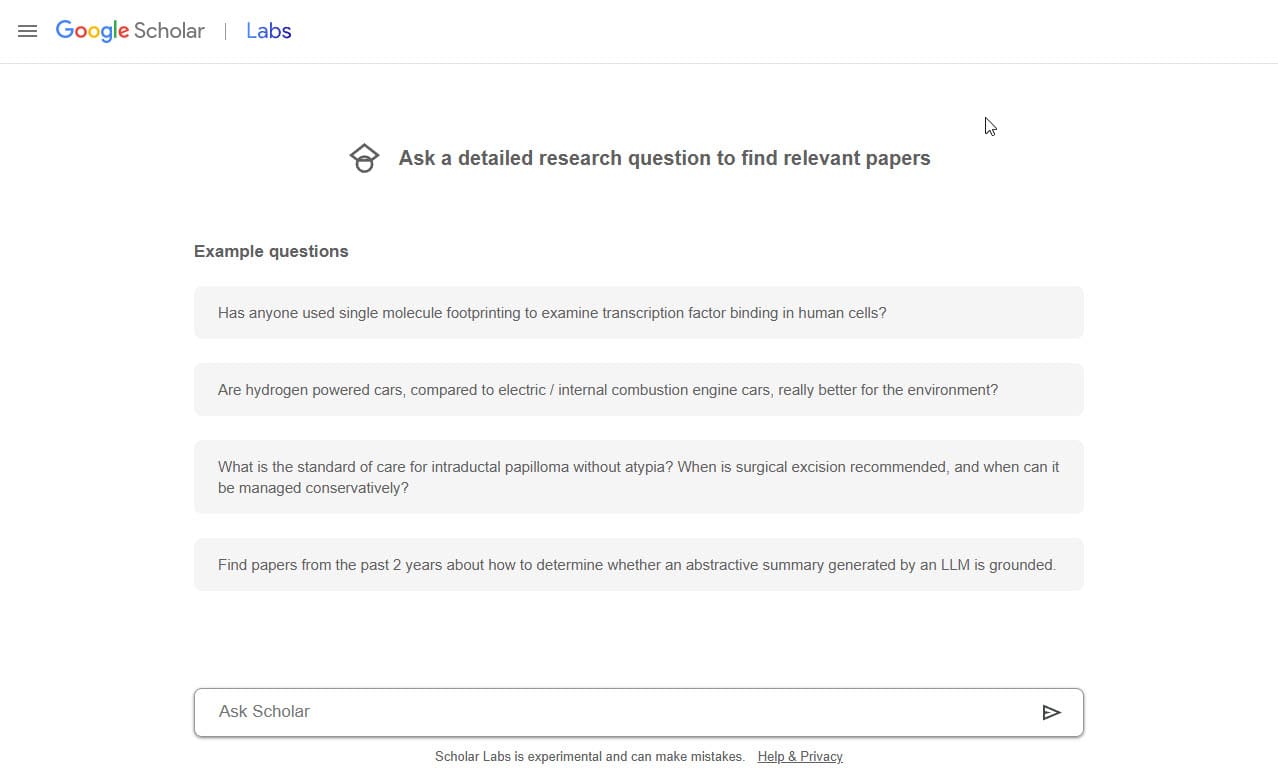
Google Scholar Labs is a new AI research tool built on top of Google Scholar and it tries to solve a simple problem: researchers often think in full questions, not in short keyword strings. Instead of forcing users to guess the right terms first, Scholar Labs lets them ask a plain-English question and then tries to find papers that answer it.
That could make the first stage of research easier for students, teachers, analysts, journalists, and curious readers. It also fits a wider shift already explored on Gromeus, where AI will speed up scientific research far more than most people expect. At the same time, the official Scholar blog says the feature is experimental, supports English for now, and is limited to some logged-in users.
Google Scholar Labs starts from full research questions
Google says Scholar Labs is built for detailed questions, not just keyword matching. In the official launch note, it says the system analyzes the question into topics, aspects, and relationships. It then searches those parts on Google Scholar and selects papers that seem to address the larger research question.
The second part matters just as much as the search itself. Scholar Labs does not only return paper titles. It also gives a short explanation of why each selected paper may matter for the question being asked. That can save time when a reader is trying to map a field quickly before opening papers one by one.
This is especially useful when the question spans several concepts at once, or when a reader is new to a field and does not yet know the standard vocabulary. In those cases, the hardest part of research is often not reading. It is knowing how to begin the search.
Google Scholar already gives Scholar Labs a broad base
Scholar Labs matters partly because it sits on top of an existing academic search system rather than a general web index. Google says Scholar broadly searches articles, theses, books, abstracts, and court opinions across many disciplines and sources. That gives the new AI layer a large research base to work from.
Google also says Scholar ranks documents using signals researchers already care about, including the full text, where the work was published, who wrote it, and how often and how recently it has been cited. That does not make the results perfect, but it does mean Scholar Labs is building on a search system that was designed for academic discovery from the start.
The broader pattern is already visible in other science stories. Gromeus recently covered how Microsoft AI discovers new battery materials in weeks instead of years, which shows the same direction in a different part of research work.
Scholar Labs feels more like guided discovery
The official Scholar Labs post says users can ask follow-up questions to dig deeper into one angle of a topic. That makes the tool feel closer to guided discovery than to a classic search box. A normal search engine mostly returns matches. Scholar Labs tries to organize the question first, then show papers with short relevance explanations.
That may be most valuable during the first hour of an investigation. A reader can start broad, see which paper clusters appear, notice what vocabulary the field uses, and then narrow the next question. This does not remove the need to read the papers. It just lowers the barrier between a hard question and a reasonable starting point.
The likely strength of the tool is not final judgment. It is early orientation. For people who already know a field well, that may save time. For people who do not, it may reduce the fear of asking a question that is too broad or too messy for a standard keyword search.
Scholar Labs is useful, but still limited
The launch comes with clear limits. Google says Scholar Labs is only open to a limited number of logged-in users, and the Scholar blog says it currently supports English questions. So this is not yet a full public rollout for every language or every researcher.
There is also a more basic limit underneath the AI layer. Google Scholar’s own help page says coverage is broad, but uninterrupted coverage of every source cannot be guaranteed. That matters because an AI search assistant can only surface papers that exist in the underlying index for that topic at that moment.
That is why better discovery does not replace critical reading. Readers still need to check whether a paper is recent enough, whether it is peer reviewed, and whether it really supports the answer they think they are getting. Research literacy tools still matter, including guides like Beall’s list identifies potential predatory journals and publishers.
Google is moving AI deeper into research workflows
Google Scholar was created to make research easier to discover and engage with. In Google’s retrospective, the company says the service began because finding academic information was difficult and often restricted. Scholar Labs keeps that same goal, but adds an AI layer before the paper list is even shown.
That move fits a broader industry pattern. AI tools are no longer only summarizing web pages or answering casual questions. More of them are being aimed at expert workflows, where the real value is reducing the time between a difficult problem and a useful first path through the information.
For now, the safest reading is simple. Scholar Labs looks like a strong front door to the literature, especially for broad or unfamiliar topics. It does not look like a substitute for doing the literature review itself.
What you can do about it
If you have access to Scholar Labs, use it as a starting tool rather than a final judge. Ask one broad question first. Then test narrower follow-up questions that isolate one part of the problem, such as population, method, outcome, or time frame.
Open the papers it recommends and verify that they really support the point you care about. It is also wise to compare the results with a normal Google Scholar search, because coverage is broad but not guaranteed. For academic or professional work, check the date, study type, citations, and journal quality before relying on any result.
Sources and related information
Google – Google Scholar Labs helps you answer research questions with AI – 2025
Google’s launch note directly supports the claim that Scholar Labs is a new AI research tool that analyzes full scholarly questions into topics and relationships, then explains why selected papers matter.
Google Scholar Blog – Scholar Labs: An AI Powered Scholar Search – 2025
The Scholar blog supports the article’s claim that Scholar Labs accepts follow-up questions, currently supports English, and is still experimental.
Google Scholar – About Google Scholar – 2025
Google’s overview page supports the claim that Google Scholar broadly searches many disciplines and sources, and ranks results using signals such as text, venue, author, and citations.
Google Scholar – Google Scholar Search Help – 2025
Google’s help documentation supports the point that Scholar includes papers, theses, books, preprints, patents, and more, while not guaranteeing uninterrupted coverage of every source.
Google – Google Scholar turns 20: Fun facts about Google Scholar – 2024
Google’s retrospective supports the historical context that Scholar began to make research easier to discover and engage with, which helps explain why Scholar Labs is a continuation of the same mission.