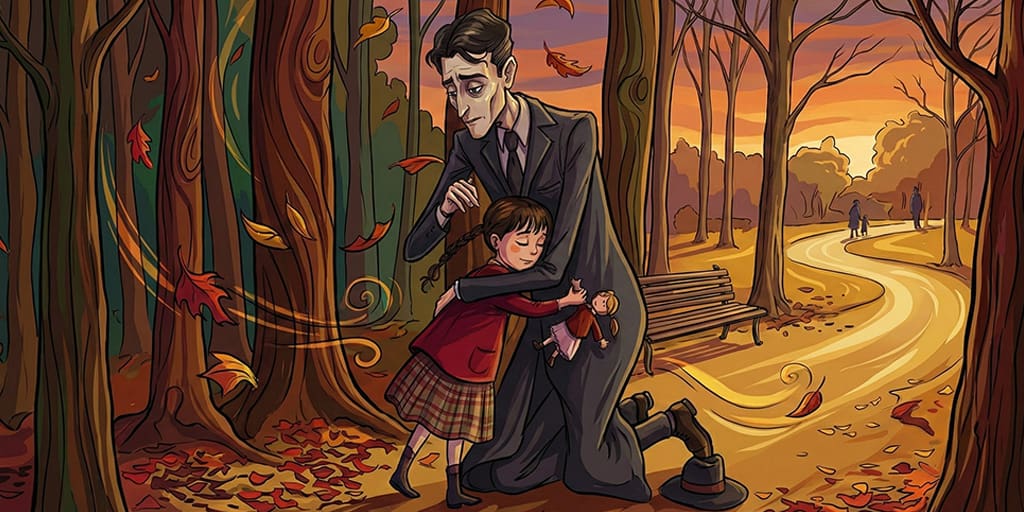
At 40, Franz Kafka (1883-1924), who never married and had no children, was walking through a park one day in Berlin when he met a girl who was crying because she had lost her favourite doll.
She and Kafka searched for the doll unsuccessfully. Kafka told her to meet him there the next day and they would come back to look for her.
The next day, when they had not yet found the doll, Kafka gave the girl a letter “written” by the doll saying “please don’t cry. I took a trip to see the world. I will write to you about my adventures.”
Thus began a story which continued until the end of Kafka’s life.
During their meetings, Kafka read the letters of the doll carefully written with adventures and conversations that the girl found adorable.
Finally, Kafka brought back the doll (he bought one) that had returned to Berlin.
“It doesn’t look like my doll at all,” said the girl. Kafka handed her another letter in which the doll wrote: “my travels have changed me.”
The little girl hugged the new doll and brought the doll with her to her happy home.
A year later Kafka died…
Many years later, the now-adult, girl found a letter inside the doll. In the tiny letter signed by Kafka it was written:
“Everything you love will probably be lost, but in the end, love will return in another way.”
Embrace change. It’s inevitable for growth. Together we can shift pain into wonder and love, but it is up to us to consciously and intentionally create that connection.
This story of Franz Kafka and the little girl in the park is a cherished piece of literary folklore. While it resonates deeply with readers worldwide, it exists in the delicate space between historical fact and poetic legend.
The heart of the story is rooted in truth: Dora Diamant, Kafka’s final companion, recounted how Kafka spent three weeks in 1923 writing daily letters to a grieving child in Berlin’s Steglitz Park. To Kafka, this wasn’t a mere distraction; he approached these “doll letters” with the same creative intensity and meticulous care as his greatest novels. He didn’t just want to distract the girl; he wanted to help her navigate the complex reality of loss through the magic of storytelling.
However, as the tale traveled through time, it gathered legendary layers. There is no historical record of a physical replacement doll or a secret letter discovered decades later. These elements, including the famous quote about love returning in another form, are beautiful additions – parables created to amplify Kafka’s empathetic spirit.
Ultimately, whether every detail is documented or not matters less than the truth it reveals about the human condition. It serves as a poignant reminder that even in our darkest moments, imagination can be a bridge to healing. We should appreciate this narrative not as a dry biographical entry, but as a testament to the power of empathy: the intentional act of turning someone else’s sorrow into a shared sense of wonder.