

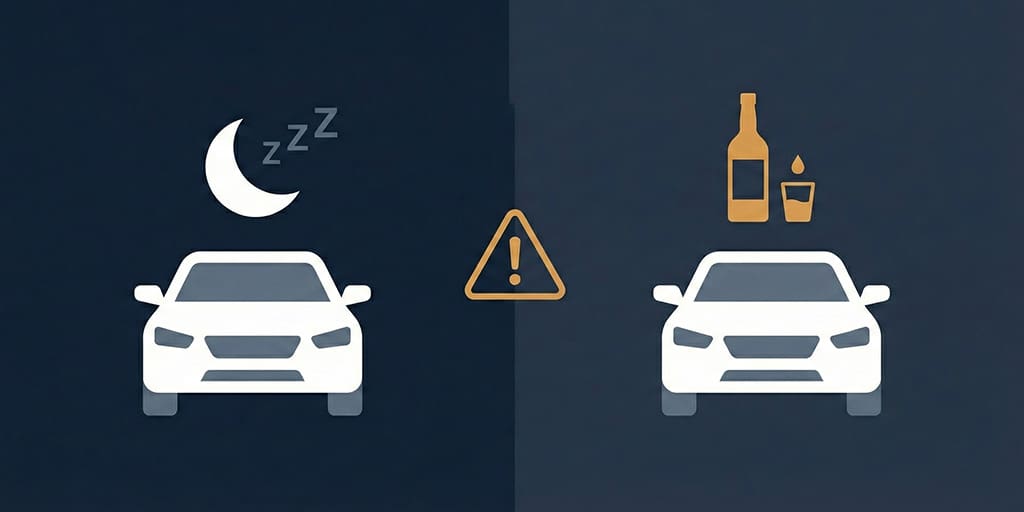
In this driving-simulator study, 24 hours of wakefulness produced greater impairment on reaction time and lane control than driving with a blood alcohol level slightly above the legal limit. A study published in BMC Public Health compared the effects of sleep deprivation and alcohol on driving performance, finding that sleep-deprived drivers showed worse reaction times and lane control than those who were mildly intoxicated. This research highlights a critical safety issue: fatigue-related impairment is often underestimated, and common countermeasures like coffee may not be effective.
The study involved 30 young adults who completed driving simulation tasks under three conditions: fully rested, after 24 hours of wakefulness, and after consuming alcohol to reach a breath alcohol concentration (BrAC) just over 22 micrograms per 100 mL breath (mean approximately 25.95 µg/100 mL), slightly above Scotland’s legal driving limit of 22 µg/100 mL. The results revealed that sleep deprivation produced greater impairment than mild alcohol intoxication across multiple performance measures.
How sleep deprivation impairs driving performance
Sleep deprivation affects multiple aspects of driving ability. After 24 hours of wakefulness, drivers show slower reaction times, reduced ability to maintain lane position, and increased risk of attention lapses and episodes of extreme drowsiness. These impairments can occur even when drivers feel they are still capable of driving safely.
In the BMC Public Health study, sleep-deprived participants had mean reaction times of 2.86 seconds, compared to 2.34 seconds in the alcohol condition. Lane tracking performance, measured as Mean Deviation from Lane Tracking (MDLT), was also worse when sleep-deprived (approximately 0.5) compared to the alcohol condition (approximately 0.3). These findings suggest that severe sleep loss can produce impairment comparable to or exceeding that from low-level alcohol intoxication.
Why coffee fails as a countermeasure
Many drivers rely on coffee or caffeine to combat fatigue, but research shows this strategy is often ineffective. In the BMC Public Health study, coffee did not improve driving performance under sleep deprivation conditions. In some cases, performance actually worsened after consuming coffee, despite participants feeling more alert.
This disconnect between subjective alertness and actual performance is particularly dangerous. Drivers may feel more capable after drinking coffee, leading to overconfidence while their driving skills remain impaired. Caffeine disrupts sleep even when taken 6 hours before bedtime, and relying on caffeine as a substitute for sleep can create a cycle of worsening fatigue.
The danger of underestimating impairment
One of the most concerning findings from sleep and driving research is that drivers often underestimate their level of impairment. Even when experiencing obvious signs of drowsiness, such as difficulty keeping eyes open or drifting between lanes, many drivers continue to drive. This overconfidence can be fatal.
Research shows that drivers who rate themselves as having “low sleepiness” may actually show moderate or severe physiological signs of drowsiness. In some studies, even after experiencing behaviors strongly associated with severe drowsiness (like 15-second eye closures), about 25% of drivers still rated their sleepiness as low. This suggests that self-assessment is unreliable when sleep-deprived.
Crash risk and sleep duration
The relationship between sleep loss and crash risk follows a clear pattern: less sleep means higher risk. Drivers who sleep less than 7 hours in the past 24 hours face increased crash risk, with the risk rising dramatically as sleep duration decreases. Those sleeping 4-5 hours have approximately 4.3 times the crash risk compared to drivers getting 7 or more hours of sleep.
For shift workers, who often work during biological night hours, the risk is compounded. Shift work and sleep disorders increase health risks and accident likelihood, particularly during the commute home after night shifts when circadian rhythms promote sleep.
What you can do about it
If you are planning to drive, prioritize getting adequate sleep beforehand. Most adults need 7-9 hours of sleep per night to maintain optimal alertness, according to consensus statements from the American Academy of Sleep Medicine and Sleep Research Society. If you have slept less than 5 hours in the past 24 hours, consider postponing driving or finding alternative transportation.
If you must drive while tired, recognize that coffee is not a reliable solution. Instead, plan for rest breaks every 2 hours, and stop immediately if you experience signs of severe drowsiness: difficulty keeping eyes open, missing exits, or drifting between lanes. A short nap (20-30 minutes) can be more effective than caffeine for restoring alertness, though it is not a substitute for adequate sleep.
Remember that feeling alert does not guarantee safe driving performance. If you have been awake for 24 hours or more, your driving ability is likely impaired regardless of how you feel.
Sources and related information
BMC Public Health – The Impact of Sleep Deprivation and Alcohol on Driving – 2020
This driving-simulator study compared performance under three conditions: fully rested, after 24 hours of wakefulness, and after mild alcohol intoxication (BrAC just over 22 µg/100 mL breath, mean ~25.95 µg/100 mL). The researchers found that 24 hours of sleep deprivation produces greater driving impairment than mild alcohol intoxication, with slower reaction times (2.86s vs 2.34s) and worse lane control (MDLT ~0.5 vs ~0.3). The study also found that coffee did not effectively counteract the impairment from sleep deprivation.
AAA Foundation – Acute Sleep Deprivation and Risk of Motor Vehicle Crash Involvement
This analysis examined the relationship between sleep duration and crash risk. The research found that drivers sleeping less than 4 hours in the past 24 hours have approximately 11.5 times the crash risk compared to drivers getting 7 or more hours of sleep. The risk increases progressively as sleep duration decreases.
AAA Foundation – Asleep at the Wheel: Drivers Unaware of How Drowsy They Really Are – 2023
This research examined drivers’ awareness of their own drowsiness levels. The study found that many drivers underestimate their level of impairment, with those rating themselves as having “low sleepiness” often showing moderate or severe physiological signs of drowsiness. Even after experiencing behaviors associated with severe drowsiness, many drivers continue to rate their sleepiness as low.