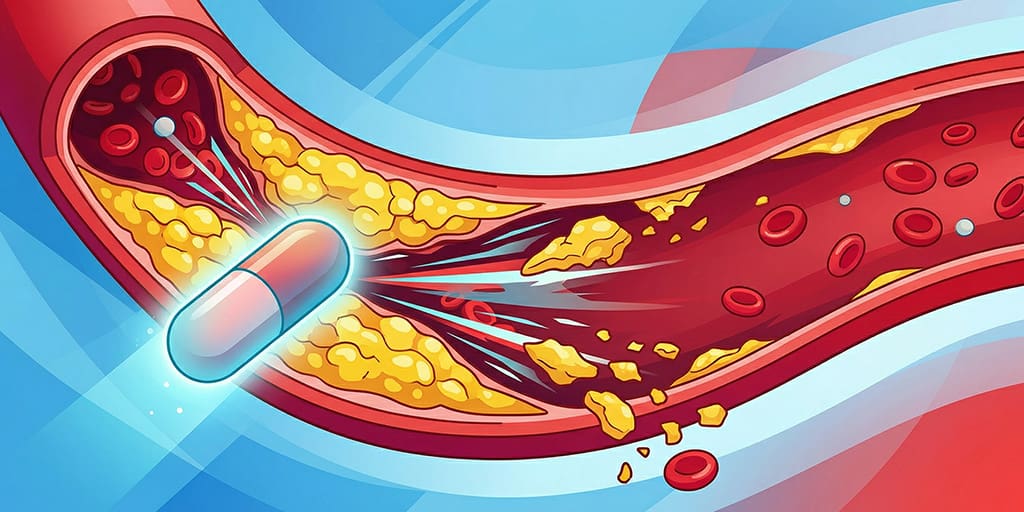
High blood LDL cholesterol is a major risk factor for atherosclerotic cardiovascular disease in mainstream medical summaries. PCSK9 is one protein that helps control how many LDL receptors the liver keeps available to clear LDL from the blood. As of 4 February 2026, the phase 3 CORALreef Lipids trial has been published in the New England Journal of Medicine, with a companion summary on American College of Cardiology journal scans.
The strongest plain-language summary supported by the peer-reviewed paper is: oral enlicitide lowered LDL-C sharply compared with placebo at 24 weeks, with adverse-event rates similar to placebo through the lipid trial’s follow-up, while proof of fewer heart attacks from this specific pill still depends on the ongoing CORALreef Outcomes trial.
This article explains the design, the updated participant counts, what changed between the 2025 topline news and the journal paper, and what lipid results do and do not show.
When statins alone are not enough, clinicians layer therapy
Statins lower LDL mainly by reducing cholesterol production in the liver. Many people still need extra help because of very high starting cholesterol, statin intolerance, interactions, or illnesses that blunt statin effect.
CORALreef Lipids required stable background lipid-lowering therapy, including at least moderate- or high-intensity statin unless statin intolerance was documented. The next section ties those rules to published participant counts, the high on-statin rate at baseline, and lipid results.
CORALreef Lipids in the NEJM: design, counts, and LDL results
The phase 3 CORALreef Lipids trial appears in the New England Journal of Medicine (4 February 2026; DOI 10.1056/NEJMoa2511002). According to the American College of Cardiology journal scan of that publication, trial authors cite observational and modeling work suggesting roughly 40% of adults with ASCVD may need LDL-lowering therapy beyond statins and ezetimibe to reach common targets, though clinics set goals individually. The scan also reports 2,909 participants randomized 2:1 to once-daily oral enlicitide 20 mg (n = 1,935) or placebo (n = 969) across 168 sites in 14 countries (mean age 63 years; 40% women), with about 97% on statins at baseline.
The same ACC summary of the peer-reviewed trial lists about 47.6% mean percent change favoring enlicitide for LDL-C at 52 weeks, 24-week shifts of about 53.4% for non-HDL-C, 50.3% for apolipoprotein B, and 28.2% for lipoprotein(a) versus placebo (p < 0.001), and similar overall adverse-event rates (64% vs 62%), discontinuations due to adverse events (3% vs 4%), serious adverse events (10% vs 12%), and mortality (0.7% vs 0.7%).
A November 2025 Merck topline had cited 2,912 randomized participants and the same 55.8 percentage-point primary LDL-C contrast, plus a post-hoc analysis (after dropping five baseline values the sponsor called not plausible) that estimated about 59.7% placebo-adjusted LDL-C lowering. That earlier disclosure remains useful background when explaining why news headlines sometimes round to “about 60 percent,” but published participant counts should follow the NEJM paper.
Oral PCSK9 inhibition hits the same pathway as injectable antibodies
Enlicitide is described as a peptide-like molecule that binds PCSK9 and blocks PCSK9 from tagging LDL receptors for removal. That means it works on the same PCSK9-LDL receptor pathway targeted by approved injectable monoclonal antibodies. Matching the pathway and showing deep LDL-C lowering in a phase 3 trial does not, by itself, prove the same long-term cardiovascular benefit for this oral molecule until dedicated outcome data are published.
An oral drug avoids injections and, in Merck’s development story, room-temperature storage compared with some biologic PCSK9 products. Trade-offs remain: reporting on the program has highlighted that the tablet is meant to be taken after an overnight fast and before breakfast because food markedly lowers exposure, so convenience is not automatic. Injectable PCSK9 antibodies are also often self-administered; the main contrast is route of administration and product-specific handling rules, not a single “clinic versus home” split.
Safety data are short-term; cardiovascular outcomes are still pending
The adverse-event profile summarized above comes from the same lipid trial window and is short-term and product-specific; it is not a substitute for longer post-marketing follow-up or for cardiovascular outcome trials.
The Merck program update that described high reported adherence in CORALreef Lipids (97% to drug, ≥97% to dosing instructions) also notes a separate CORALreef Outcomes cardiovascular study with completed enrollment above 14,500 participants. Until that trial reports, LDL-C changes in CORALreef Lipids should be read as blood-marker results, not proof yet of fewer heart attacks for individuals. The ClinicalTrials.gov record for CORALreef Lipids still documents the phase 3 lipid-focused design.
What you can do while outcome evidence matures
If you use statins or worry about LDL, ask your clinician how your goals are set and whether an add-on makes sense. Do not change prescription medicines based on trial summaries alone. For background on how statins are used in care, see MedlinePlus information on statins. Diet pattern, activity, smoking, blood pressure, and diabetes control still belong in any broad prevention conversation.
Sources and related information
New England Journal of Medicine – CORALreef Lipids trial (enlicitide) – 2026
The peer-reviewed CORALreef Lipids trial report is the primary source for design, efficacy, and safety as now published (4 February 2026).
American College of Cardiology – CORALreef Lipids journal scan – 2026
The ACC journal scan summarizes participant counts, 24- and 52-week LDL-C results, secondary lipids, safety, and the high baseline statin rate from the NEJM paper for clinicians.
Merck – Enlicitide CORALreef Lipids topline news release – 2025
The November 2025 company release documents earlier headline participant totals, the post-hoc LDL-C analysis, adherence, and CORALreef Outcomes enrollment context.
Fierce Biotech – Enlicitide dosing and oral PCSK9 context – 2025
The Fierce Biotech article discusses fasting-related dosing requirements for enlicitide and broader oral-versus-injectable PCSK9 market context.
MedlinePlus – Cholesterol overview – n.d.
The MedlinePlus cholesterol overview explains why clinicians track LDL cholesterol in cardiovascular prevention.
MedlinePlus Genetics – PCSK9 gene overview – 2020
The MedlinePlus Genetics PCSK9 overview gives plain background on the PCSK9 protein.
ClinicalTrials.gov – CORALreef Lipids NCT05952856 – 2026
The registry record for NCT05952856 documents the registered phase 3 lipid trial structure.