

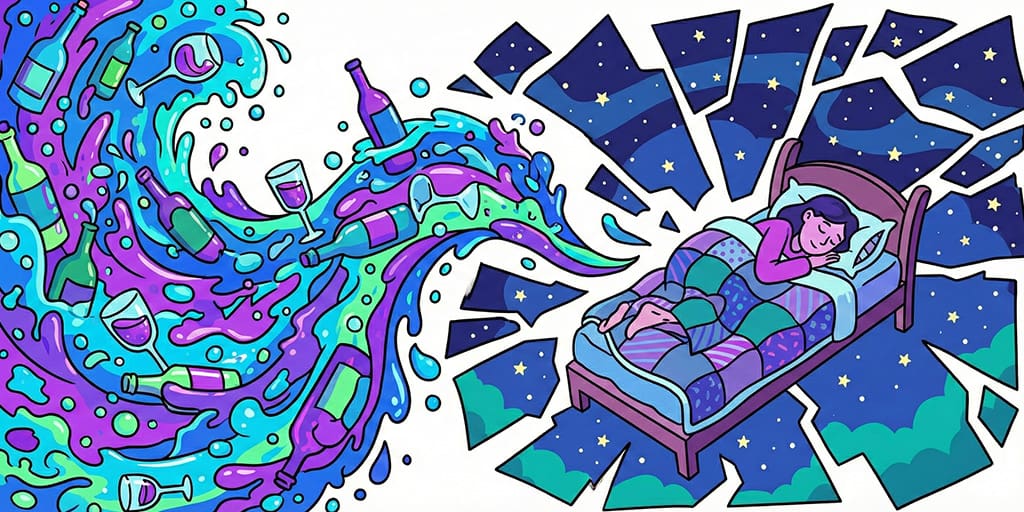
Chronic alcohol use creates profound and long-lasting changes in sleep that persist well after people stop drinking. While alcohol may initially help people fall asleep faster, it ultimately disrupts sleep quality and architecture in ways that can contribute to alcohol dependence and increase the risk of relapse. Understanding how alcohol affects sleep is crucial for both preventing and treating alcohol use disorders.
Research shows that sleep disturbances are among the most persistent problems for people recovering from alcohol dependence. Even after months or years of abstinence, many individuals continue to experience poor sleep quality, insomnia, and abnormalities in sleep stages. These sleep problems are not just symptoms of alcohol use disorder; they are significant predictors of relapse risk.
Alcohol’s acute effects on sleep architecture
When consumed before bedtime, alcohol produces immediate but complex effects on sleep. Initially, alcohol acts as a sedative, reducing the time it takes to fall asleep (sleep onset latency). Alcohol also increases slow-wave sleep (deep, restorative sleep) in the first half of the night, especially when blood alcohol concentration is high.
However, these initial benefits are short-lived. As the body metabolizes alcohol during the night, sleep quality deteriorates. The second half of the night typically shows increased awakenings, lighter sleep stages, and poorer sleep continuity. Alcohol also suppresses REM sleep (rapid eye movement sleep, associated with dreaming and memory consolidation) during the first half of the night, delaying REM onset and reducing total REM time.
Chronic alcohol use and persistent sleep changes
With chronic alcohol use, the sleep disruptions become more severe and persistent. During active drinking, people with alcohol use disorder experience increased wakefulness, sleep fragmentation, and disruptions in both sleep macroarchitecture (overall sleep stage patterns) and microarchitecture (finer features like sleep spindles).
During withdrawal and early abstinence, sleep problems often worsen. People experience increased wakefulness, more frequent awakenings, altered REM latency, and shifts in REM distribution. The suppression of REM sleep during drinking is often followed by a “REM rebound” effect, where REM sleep increases sharply during withdrawal and may remain elevated for days or weeks.
Even after months or years of abstinence, many people continue to show sleep abnormalities. Slow-wave sleep may improve over time but often remains below normal levels for many months. Some REM parameters may normalize, but elevated REM pressure (shorter latency to REM, increased REM percentage or density) often persists. Sleep efficiency, total sleep time, and sleep continuity measures frequently remain impaired.
How sleep disruption contributes to dependence and relapse
Sleep problems play a critical role in both the development of alcohol dependence and the risk of relapse. When alcohol initially helps people fall asleep faster or feel like it improves sleep onset, this can create a self-reinforcing mechanism. Over time, people may continue drinking not just for intoxication, but to get relief from sleep disturbances that alcohol itself has created.
Sleep problems are common and may predict relapse risk; however, findings vary by how sleep is measured. Associations between general sleep disturbance scores (e.g., PSQI) and relapse are mixed across studies. However, using alcohol as a hypnotic is a clearer risk marker. Subjective sleep complaints during early recovery are associated with craving and mood symptoms.
In a 12-month observational cohort, using alcohol to help fall asleep was associated with relapse (OR 3.26, 95% CI 1.33-7.95). The persistence of REM abnormalities and REM rebound effects, often accompanied by vivid or disturbing dreams, can be especially distressing and may lead people to drink again to suppress these unpleasant sleep experiences.
Neurochemical mechanisms underlying sleep disruption
Alcohol disrupts sleep through multiple neurochemical pathways. It enhances GABAergic (gamma-aminobutyric acid) activity, which promotes sedation, while suppressing glutamatergic systems. Alcohol also affects acetylcholine and serotonin systems, all of which are involved in sleep regulation.
Alcohol disrupts sleep homeostasis, the balance of sleep pressure that drives slow-wave sleep. By reducing wakefulness and distorting the accumulation of “sleep need,” alcohol interferes with the body’s natural sleep-wake regulation. Alcohol also disrupts circadian rhythms, shifting REM timing, suppressing core circadian outputs, and potentially weakening cues like light and melatonin that help regulate sleep-wake cycles.
These neurochemical changes likely contribute to why sleep disturbances persist long after alcohol use stops. The brain’s sleep-regulating systems have been altered by chronic alcohol exposure, and recovery takes time.
Individual differences and vulnerability
Adolescents appear to be more susceptible to alcohol’s effects on sleep, which may contribute to the development of alcohol use disorders in this population. Individual factors such as genetics, age, and overall health also influence how alcohol affects sleep and how quickly sleep recovers after abstinence.
Treatment implications and recovery
Given the strong link between sleep problems and relapse risk, addressing sleep should be a priority in alcohol use disorder treatment. Sleep disruptions are among the most persistent problems in recovery, and improving sleep may help reduce relapse risk.
Behavioral interventions like Cognitive Behavioral Therapy for Insomnia (CBT-I) have shown promise. Studies have found improvements in subjective sleep quality, reduced sleep latency, and fewer awakenings even weeks or months into recovery. However, larger studies are needed to determine whether these sleep improvements translate to significant reductions in relapse rates.
Clinicians treating alcohol use disorder should routinely assess sleep both subjectively (through sleep questionnaires) and, when possible, objectively (through polysomnography or actigraphy). Sleep features should factor into relapse risk evaluation, as sleep problems are significant predictors of outcomes.
Some sleep markers begin improving within 1-2 weeks of abstinence, including sleep latency, efficiency, and slow-wave sleep. However, REM abnormalities may persist longer, and full normalization of all sleep parameters may take many weeks to months. For some people, not all sleep parameters return to normal levels.
What you can do about it
If you are struggling with alcohol use and sleep problems, it is important to understand that these issues are interconnected. Using alcohol to help with sleep can create a cycle where sleep problems worsen, leading to more alcohol use. Breaking this cycle requires addressing both alcohol use and sleep problems together.
If you are in recovery from alcohol use disorder, be aware that sleep problems are common and may persist for months. Caffeine disrupts sleep even when taken 6 hours before bedtime, so avoiding caffeine, especially in the afternoon and evening, may help improve sleep quality during recovery.
Consider working with healthcare providers who can help address both alcohol use and sleep problems. Behavioral interventions for insomnia, sleep hygiene practices, and careful use of sleep medications (when appropriate and under medical supervision) may all be helpful. Remember that sleep deprivation impairs driving more than legal alcohol limits, so addressing sleep problems is important for both recovery and safety.
Be patient with sleep recovery. While some improvements may occur within weeks, full normalization of sleep can take months. Tracking your sleep patterns and working with healthcare providers can help monitor progress and adjust treatment approaches as needed.
Limitations and quality of evidence
Much of the research on alcohol and sleep has limitations. Many studies have small sample sizes, and longitudinal data over several years is limited. Additionally, how treatments for insomnia in alcohol-dependent populations affect long-term relapse rates needs more investigation.
However, the overall pattern of findings is consistent: chronic alcohol use disrupts sleep in ways that persist well into abstinence, and these sleep problems are significant predictors of relapse risk. The evidence supports addressing sleep as an important component of alcohol use disorder treatment.
Sources and related information
Alcohol and the Sleeping Brain – Review Article – 2018
This comprehensive review examines how alcohol affects sleep architecture and how sleep disturbances contribute to alcohol dependence and relapse risk. The review found that sleep disturbances persist well into abstinence, even after months or years, and that sleep problems are strong predictors of relapse. The review also explores neurochemical mechanisms and adolescent vulnerability to alcohol-related sleep disruption.
American Journal on Addictions – The Association Between Sleep Disturbances and Alcohol Relapse – 2015
This 12-month observational cohort study examined the relationship between sleep problems and relapse risk in people with alcohol use disorder. The research found that using alcohol to help fall asleep was associated with relapse (OR 3.26, 95% CI 1.33-7.95), while general sleep disturbance scores (PSQI) at admission or discharge were not significantly associated with relapse. This highlights that using alcohol as a hypnotic is a clearer risk marker than general sleep problems.
Sleep Foundation – Alcohol and Sleep
This resource provides an overview of how alcohol affects sleep, including its effects on slow-wave sleep and REM sleep. The information explains that alcohol initially increases slow-wave sleep in the first part of the night, but as it is metabolized, sleep quality deteriorates in the second half of the night.
European Journal of Psychiatry – Sleep Features in Alcohol Use Disorder – 2023
This study examined sleep features in people with alcohol use disorder during abstinence. The research found that sleep abnormalities persist even after months of abstinence, including reduced slow-wave sleep, elevated REM sleep, increased sleep latency, and poor sleep efficiency.
Addiction Science & Clinical Practice – Sleep Disturbances in Alcohol Dependence – 2016
This article reviews sleep disturbances in alcohol dependence and their implications for treatment. The research discusses REM rebound effects and elevated REM pressure that persist during abstinence, and emphasizes the importance of behavioral interventions like CBT-I for improving sleep in recovery.
